Hi, Rich here.
This is one of those ideas I’ve been chewing on for a long time, and lately it’s started coming together into something I can actually write down and look at.
The basic idea is pretty simple:
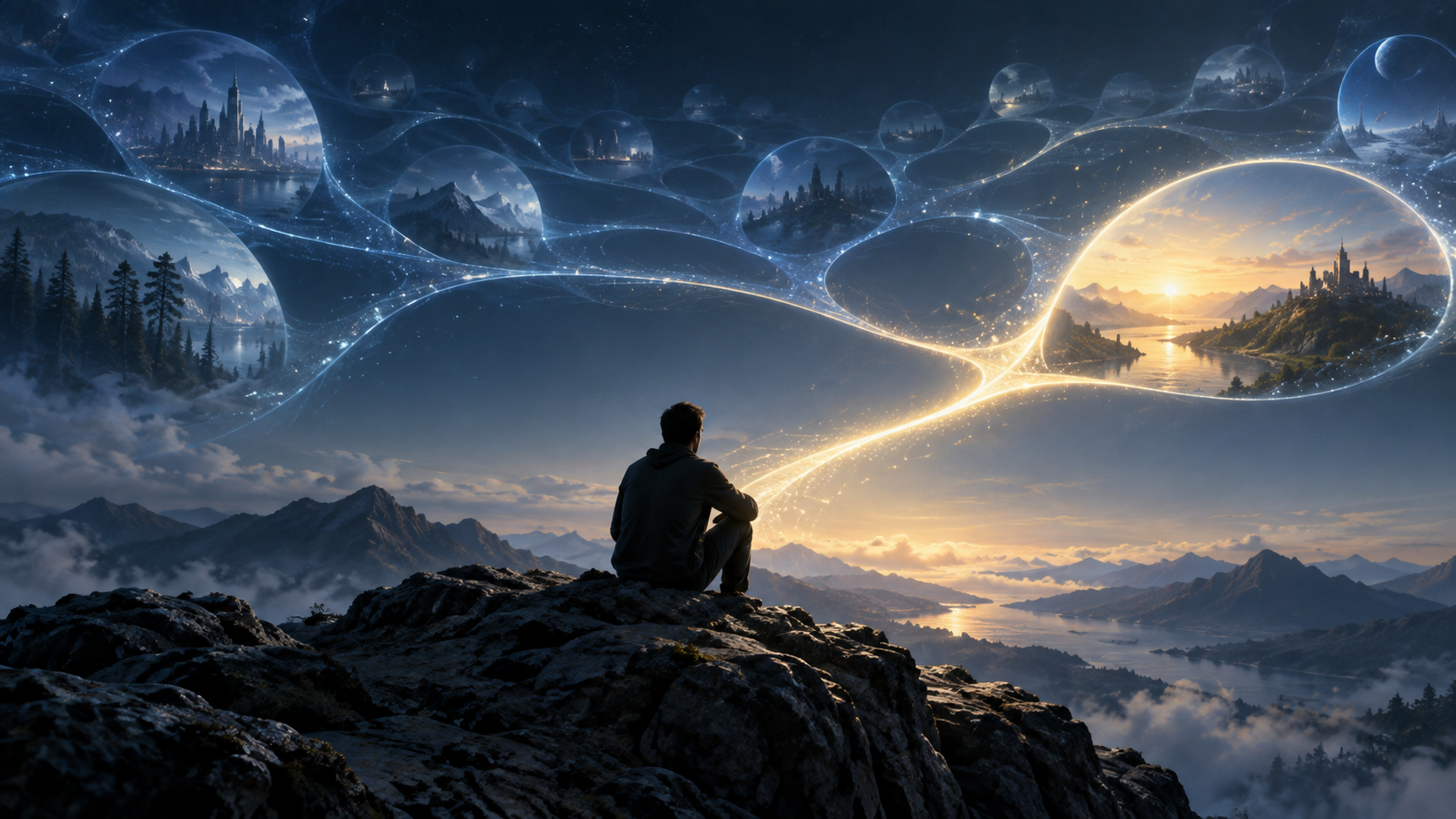
What if reality is being rendered moment by moment, and what we think, feel, expect, imagine, focus on and carry forward from the past all help influence what gets rendered next?
I’m not presenting this as some final answer carved into stone. It’s a working model. I’m still experimenting with it, arguing with it, changing parts of it, and trying to see where it breaks.
But as a model, it explains a hell of a lot.
The simplest version looks something like this:
Previous Experience → Beliefs, Assumptions and Expectations → Thoughts, Images, Emotions and Intentions → Attention and Emotional Weighting → Selection from Possible Outcomes → Next Rendered Moment
And that rendered moment becomes part of the next round.
So the system keeps feeding itself.
Yesterday gets carried into today.
Or, the way I sometimes put it:
Yesterday — slightly modified into today.
Most of us are not starting every morning with a blank canvas.
We wake up carrying yesterday’s expectations, emotional charge, habits, identity, worries, assumptions, routines and memories.
So even if we consciously say, “I want something different,” the rest of the system may still be feeding the renderer the same old material.
That creates what I think of as rendering inertia.
The next moment tends to look a lot like the last one because we are carrying so much of the same information forward.
Here’s one way I’ve been thinking about it:
Possibility Space × Prior Experience × Current Context × Prompt and Intention × Emotional Weighting × Attention × Assumptions and Expectations = The Next Rendered Moment
Don’t get hung up on the math-looking part.
I’m not claiming this is a physics equation.
It’s a map.
A way of showing the ingredients that may be influencing what gets rendered next.
One of the things that helped me think about this was working with generative AI.
With AI, the output depends on more than just one sentence you type.
There’s the prompt.
There’s prior training.
There’s context.
There are weights.
There’s continuity from what came before.
There’s the amount of attention being given to one thing versus another.
And I started wondering:
What if consciousness works in a somewhat similar way?
Maybe thoughts act a little like prompts.
Maybe mental images act like image prompts.
Maybe memories act like source material.
Maybe emotions act like weighting.
Maybe attention tells the system where to allocate resources.
Maybe beliefs and assumptions act like deeply trained parameters.
And maybe the next moment is what gets rendered from all of that.
This is where I think a lot of manifestation work gets too big too fast.
People try to render:
- “My perfect life.”
- “My dream relationship.”
- “Ten million dollars.”
- “Complete enlightenment.”
Whatever.
That’s a hell of a lot of rendering.
I’m more interested in smaller believable segments.
The next fifteen minutes.
The next conversation.
This afternoon.
The next decision.
Because maybe reality isn’t being rendered as one giant finished movie.
Maybe it’s being generated in segments.
Another piece I keep coming back to is this:
Maybe the thing we are trying to create is not the first thing to work on.
Maybe the state comes first.
If I want a peaceful conversation, what state am I bringing into it?
If I want a different kind of day, what am I continually prompting, weighting, expecting and carrying forward into the next frame?
That question has become one of my favorites:
What am I continually prompting, weighting, expecting, and carrying forward into the next frame?
Try this for one small segment of your day.
Pick something ordinary.
The next phone call.
The next trip to the store.
The next hour.
Then ask:
- What am I expecting?
- What am I imagining?
- What emotional charge am I carrying?
- What am I paying attention to?
- What story am I assuming is already true?
Then deliberately change one or two of those inputs.
Not by pretending you believe something ridiculous.
Just move the dial a little.
Then watch what happens.
I don’t know exactly how literal this model is.
Maybe consciousness really is functioning like some kind of render engine.
Maybe this is simply a useful way to think about attention, expectation, belief and experience.
Maybe it’s both.
I’m still playing with it.
But I keep coming back to the same thought:
Reality may be rendered through us, not merely at us.
And if that’s even partly right, then learning how we prompt, weight, expect, imagine and attend may be a much bigger deal than we usually think.
— Rich